Introduction to Large Language Models

What Is an LLM? Introduction to Large Language Models

If you use ChatGPT, Claude, Gemini, or any other modern AI tool, you have probably heard the term Large Language Model.

But what exactly does LLM mean?

LLM stands for Large Language Model. It is one of the main technologies behind today’s AI chatbots and many other AI-powered applications.

The good news is that you don’t need to be a programmer or AI expert to understand how it works.

In this guide, we’ll explain what an LLM is, how large language models work, what they can do, and why they have become so important.

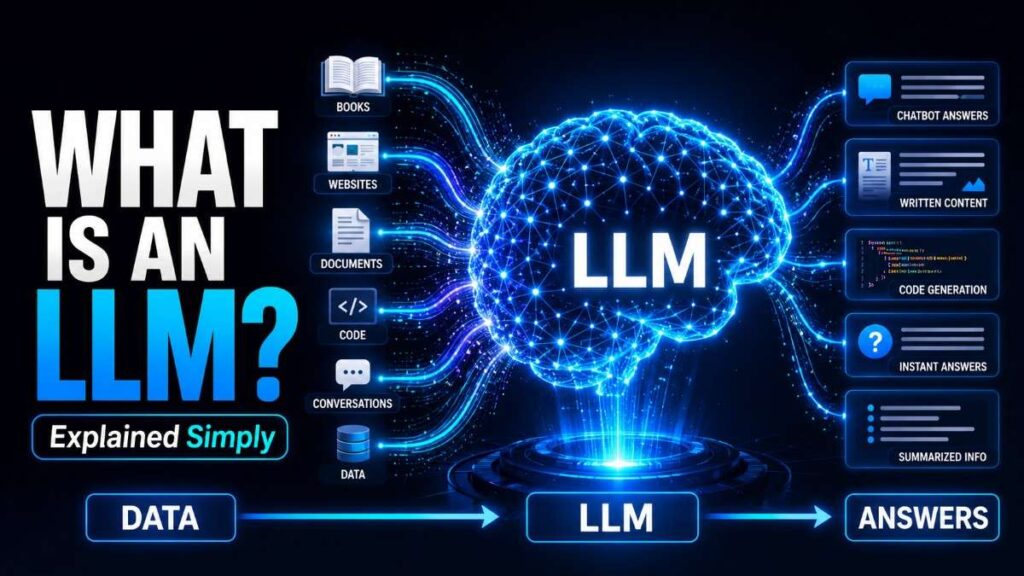
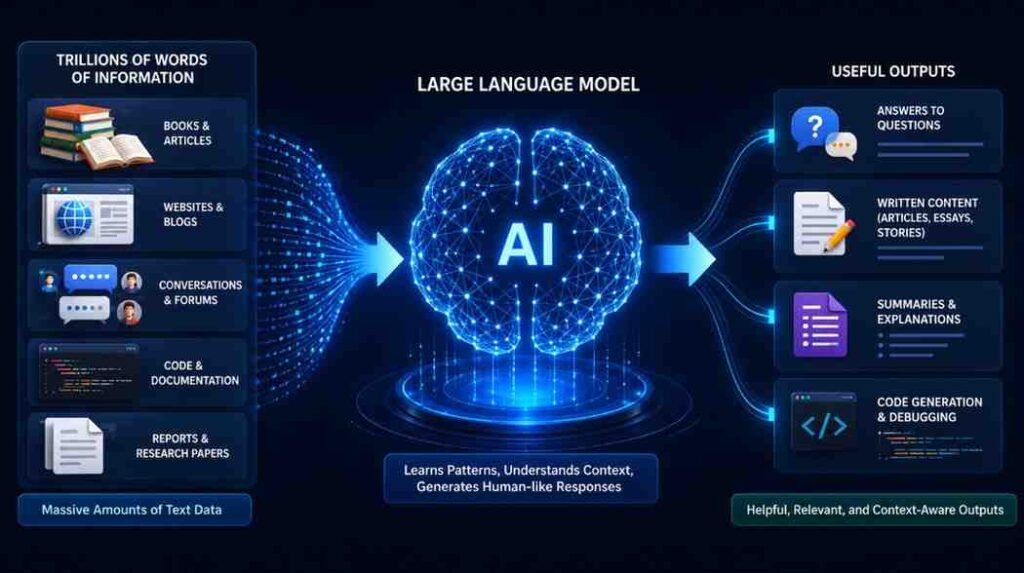
An LLM, or Large Language Model, is an AI system that has been trained using a huge amount of text.

This training helps the model learn patterns in language. It learns things such as how words are used, how sentences are structured, how questions and answers are related, and how different ideas connect with each other.

For example, if you ask an LLM:

“What is the capital of France?”

It can generate an answer such as:

“The capital of France is Paris.”

But an LLM can do much more than answer simple questions.

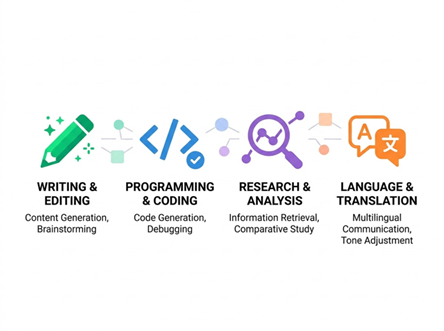
It can write emails, summarize documents, explain complicated topics, generate computer code, translate text, brainstorm ideas, and much more.

The important thing to understand is that an LLM does not work exactly like the human brain.

At its core, a language model generates text by predicting what should come next based on the context it has received and the patterns it learned during training.

That simple idea becomes extremely powerful when the model is trained on enormous datasets with billions or even trillions of tokens.

What Is an Large Language Models ?

Why Is It Called a "Large" Language Model?

There are two important words in LLM: Large and Language.

The “language” part is easy. These models are designed to work with human language and, increasingly, other types of information such as images, audio, and video.

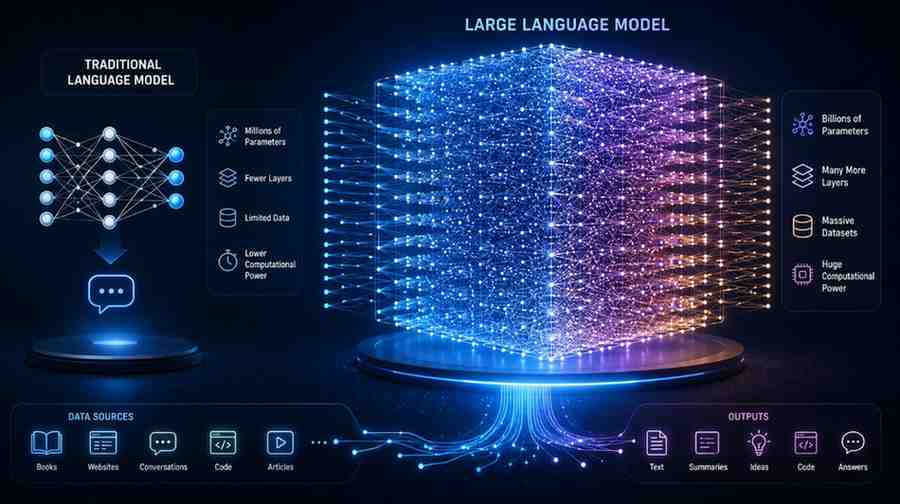
The “large” part refers to the enormous scale involved.

Modern LLMs can contain billions of parameters. Parameters are values inside the model that are adjusted during training so the model can learn patterns from its training data.

You don’t need to understand the mathematics behind parameters to use an Large Language Model.

Think of them roughly as tiny adjustable settings that help the model recognize and reproduce patterns.

More parameters do not automatically mean a model is better at everything, but large models can learn very complex patterns when they are trained properly.

The easiest way to understand an LLM is to break the process into a few basic steps.

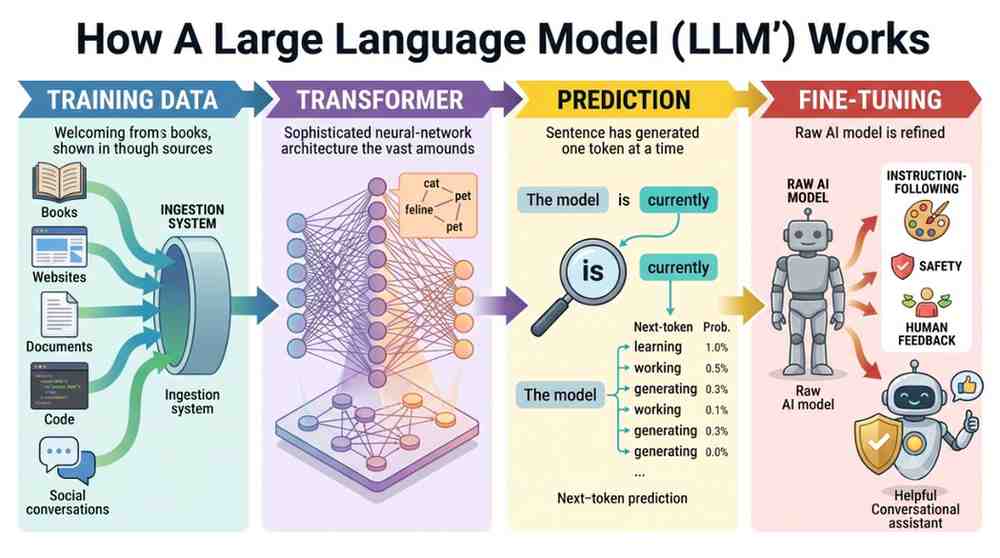
1. The Model Is Trained on Huge Amounts of Data

Let’s dive into the main features and see what they can do for you.

Before you can chat with an LLM, the model first needs to be trained.

During training, the model processes enormous amounts of text from sources such as books, websites, articles, documentation, code, and other datasets.

The exact data used depends on the model and its developer.

The model isn’t simply storing every sentence it sees like a giant database.

Instead, training adjusts the model’s parameters so that it becomes better at recognizing patterns in language.

For example, after seeing many examples of English sentences, the model can learn patterns such as:

“The sky is…”

A likely continuation might be:

“blue.”

Of course, real LLMs operate on a vastly more complicated level than this simple example.

Huge Amounts of Data

2. Transformers Help the Model Understand Context

Modern LLMs are largely based on an architecture called the Transformer.

You don’t need to understand all the mathematics behind transformers to understand their basic purpose.

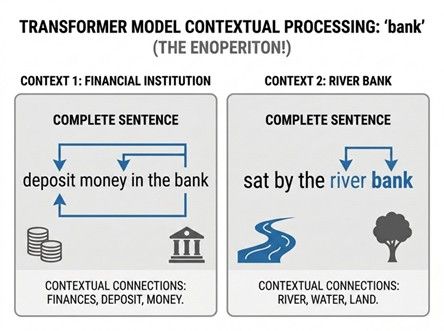
A transformer helps a model determine how different parts of the input relate to each other.

For example, consider this sentence:

“I went to the bank to deposit money.”

Here, “bank” refers to a financial institution.

Now consider:

“We sat beside the bank of the river.”

Here, “bank” has a completely different meaning.

Understanding the surrounding words helps the model determine which meaning makes sense.

This ability to work with context is one of the reasons transformer-based models became so important in modern AI.

3. The Model Predicts What Comes Next

When you send a message to an LLM, the model processes your input and generates a response piece by piece.

It predicts what token should come next based on the context.

A token can be a complete word, part of a word, punctuation, or another small piece of text.

For example, if you write:

“The largest planet in our solar system is…”

the model can predict that the next token is likely related to Jupiter.

The process continues repeatedly until the model has generated the response.

This happens incredibly quickly, which is why it can feel like you’re having a conversation with another person.

Are LLMs Actually Thinking?

This is one of the most common questions about AI.

The answer depends on what we mean by “thinking.”

LLMs can perform surprisingly sophisticated tasks. They can explain concepts, solve many problems, write programs, analyze information, and sometimes carry out multi-step reasoning.

However, that does not mean they think in exactly the same way humans do.

An LLM is a machine-learning system that generates outputs based on learned patterns, its current context, and the instructions it receives.

This is also why an LLM can sometimes produce an answer that sounds extremely confident but is still wrong.

These incorrect or fabricated answers are often called AI hallucinations.

So even when an AI response sounds convincing, important information should still be checked.

Popular Examples of LLMs

You’ve probably already interacted with an LLM

without realizing how much technology is behind it.

Some well-known AI model families include:

Introduction to Large Language Models: A Simple Beginner's Guide

Serial Image Name Rating Pricing Compatibility Actions
1 OpenAI logo
★★★★★
4.5
Freemium
Web,Windows,macOS,iOS,Android
Details
2 Claude AI logo
★★★★★
4.5
Subscription
Windows,macOS,Android,iOS
Details
3 Google Gemini logo
★★★★★
4.8
Subscription
Web-based, Windows, Mac, Android, iOS
Details
4 Meta AI logo
★★★★★
4.5
Free
Windows, Mac, Android, iOS
Details
5 DeepSeek AI logo
★★★★★
4.5
Free
Web-based, Windows, Mac, Linux
Details

OpenAI GPT

OpenAI’s GPT models power ChatGPT and are used for tasks such as writing, coding, research, analysis, and general AI assistance.

Anthropic Claude

Claude is Anthropic’s family of AI models. It is widely used for writing, coding, analysis, document work, and other knowledge-based tasks.

Google Gemini

Gemini is Google’s AI model family. It is designed to work with different types of information, including text and other modalities depending on the model and product.

Meta Llama

Meta’s Llama family is particularly important in the open-model ecosystem. Developers and organizations can use Llama models in different environments and build applications around them.

DeepSeek

DeepSeek has also become an important name in the AI model ecosystem, particularly among developers and businesses interested in capable models and efficient AI systems.

The AI industry changes very quickly, though. New models and versions are released frequently, so today’s model rankings can become outdated surprisingly fast.

What Can You Do With an LLM?

This is where LLMs become really useful.

You can use them for everyday tasks as well as professional work.

Writing and Editing

An LLM 

can help you:

  • Write blog posts
  • Create emails
  • Rewrite content
  • Improve grammar
  • Generate product descriptions
  • Create social media content
  • Brainstorm headlines

Summarizing Information

Have a long document that you don’t have time to read completely?

An LLM can help summarize the key points and explain the important information in simpler language.

Coding

Developers use LLMs to:

  • Generate code
  • Explain existing code
  • Find bugs
  • Write documentation
  • Convert code between languages
  • Create test cases

They can be useful coding assistants, although generated code should always be reviewed before being used in production.

Research and Brainstorming

You can also use an LLM as a research assistant for tasks such as organizing ideas, comparing concepts, generating questions, and explaining unfamiliar subjects.

For factual or current information, however, it’s important to use reliable sources and verify important claims.

Translation

LLMs can translate and rewrite content across many languages.

They can also help adjust the tone of a translation, such as making it more formal, friendly, or suitable for a business audience.

AI Agents

The next step is going beyond simply generating text.

Modern AI systems can sometimes connect an LLM with external tools.

For example, an AI agent might be able to search the web, interact with software, analyze files, or perform other actions.

In that situation, the LLM becomes part of a larger system rather than working alone.

LLM vs Chatbot: Are They the Same Thing?

Not exactly.

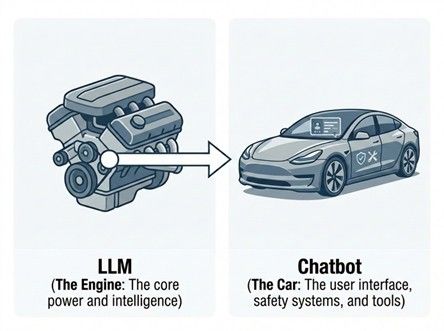
An Large Language Model is the underlying AI model, while a chatbot is an application or interface that allows people to interact with an AI system.

Think about it this way:

LLM = the engine

Chatbot = the car you interact with

A chatbot can use an Large Language Model underneath it, but it may also include other technologies such as search, databases, APIs, memory, safety systems, and external tools.

That’s why two different AI products can use similar underlying models but provide very different experiences.

What Is RAG?

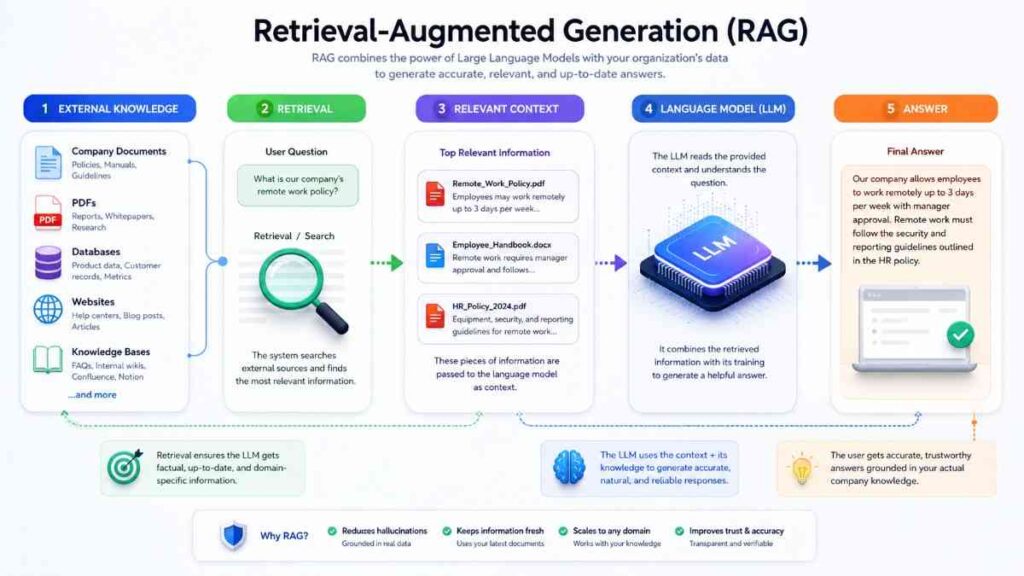
Another important concept is RAG, which stands for Retrieval-Augmented Generation.

One limitation of a language model is that its internal knowledge comes from its training and may not contain the latest information.

RAG provides a way for an AI application to retrieve relevant information from an external source and give that information to the model as context.

For example, imagine a company has thousands of internal documents.

Instead of expecting the LLM to know everything about those documents from its original training, a RAG system can search the company’s documents, find relevant information, and provide it to the LLM before generating an answer.

This can make AI applications much more useful for company-specific or frequently changing information.

Why Are LLMs Important?

LLMs have changed how people interact with software.

For decades, using software usually meant learning menus, buttons, commands, or complicated interfaces.

With AI systems, people can increasingly describe what they want using normal language.

Instead of learning a complicated command, you might simply say:

“Summarize this report and give me the three most important points.”

That shift is significant.

LLMs are becoming a new interface for interacting with information and software.

Businesses are also using them for customer support, coding, document processing, content creation, internal knowledge systems, research, and automation.

What Are the Limitations of LLMs?

LLMs are powerful, but they are definitely not perfect.

They can:

  • Give incorrect information
  • Misunderstand a question
  • Generate outdated information
  • Make up sources or facts
  • Produce biased or misleading content
  • Struggle with some complex reasoning tasks
  • Give confident answers when they are actually uncertain

That’s why you shouldn’t blindly trust every AI-generated answer.

For everyday brainstorming, writing, and productivity, an LLM can be extremely useful.

For important decisions involving money, law, medicine, security, or other high-stakes areas, information should be independently verified using trustworthy sources and qualified professionals where appropriate.

The Future of Large Language Models

LLMs are still developing quickly.

The future isn’t just about making models bigger.

AI developers are also working on improving reasoning, efficiency, multimodal capabilities, tool use, reliability, personalization, and the ability of AI systems to complete multi-step tasks.

We’re also seeing a shift from simple chatbots toward AI agents that can interact with software and complete tasks on behalf of users.

That could make AI much more useful in everyday business and personal workflows.

Final Thoughts

So, what is an LLM?

In simple terms, a Large Language Model is an AI system trained on huge amounts of data so it can understand and generate language and perform many tasks involving information.

The basic idea may sound simple: learn patterns and predict what comes next.

But when that process is combined with enormous datasets, powerful computing, transformer-based architectures, instruction tuning, and additional tools, the result can be incredibly capable.

And that’s why LLMs have become one of the most important technologies behind today’s AI revolution.

If you’re just getting started with AI, understanding LLMs is a great first step.

From here, the next things worth learning are prompt engineering, RAG, AI agents, and how businesses are using AI in real-world workflows.

Frequently Asked Questions

LLM stands for Large Language Model.

An LLM is an AI model trained on large amounts of data that can understand and generate text and perform many language-related tasks.

ChatGPT is an AI application that uses OpenAI’s GPT family of models. The chatbot interface and the underlying model are not exactly the same thing.

An LLM processes the input and predicts the next token based on the context and patterns learned during training. It repeats this process to generate a complete response.

Yes. LLMs can produce incorrect or misleading answers, sometimes with high confidence. Important information should therefore be verified.

AI is the broader field of artificial intelligence. An LLM is a specific type of AI model designed primarily around language and, in many modern systems, other types of information as well.

Good next topics include prompt engineering, RAG, AI agents, embeddings, vector databases, and AI automation.

In one sentence: An LLM is a powerful AI model that learns patterns from huge amounts of data and uses those patterns to understand context and generate useful responses.

Scroll to Top